

Most Marketing Plays on People’s Unconscious Limiting Beliefs
Updated: Sep 17

Why do people buy things they do not need, follow trends they do not truly value, or seek self-worth through what they own? Marketing psychology can influence consumer behavior by linking products, lifestyles and messages to existing emotions, social cues, desires and unconscious (unidentified) beliefs. Research in consumer psychology shows that buying decisions can be shaped by influences people are not fully aware of, although conscious evaluation also matters. This article explores limiting beliefs, advertising, consumerism, external validation and cultural conditioning and how awareness can help separate genuine needs from manufactured wants.
How Marketing Psychology and Limiting Beliefs Shape Consumer Behavior
People do not always search for what is true; they often search for what feels reassuring, familiar or desirable.
Our decisions are strongly influenced by existing beliefs, emotions and expectations, which do not necessarily correspond with facts.
The internet gives us access to enormous amounts of information, but algorithms increasingly prioritise what captures attention and matches existing interests rather than what is necessarily most useful or true.
Marketing can then build on those preferences, turning wants into perceived needs and encouraging people to desire things they may never have considered necessary in the first place:
people often prefer information that confirms what they already want to believe;
decisions are often shaped by beliefs and emotions, not only by facts;
online platforms increasingly show people what keeps their attention, not necessarily what is most truthful or useful;
marketing can then turn those preferences into desires for things people did not originally need.

Encouraging people to avoid discomfort through more and more diversions can make them increasingly dependent on comfort and less able to face what is difficult.

Giving people whatever they want is not necessarily freedom when those wants themselves are being driven by fear, avoidance or limiting beliefs. What appears to be choice can become another cycle of distraction, comfort-seeking and temporary pleasure.

Excessive indulgence can therefore become a way of avoiding deeper truths or uncomfortable questions rather than resolving them.
True freedom is not simply having the privilege to choose everything we want when those desires are shaped by limiting beliefs. It is also having the awareness to recognise those beliefs and decide whether we still wish to act from them.

Temporary diversions - whether objects, entertainment or substances used as escape - may offer relief, but they do not necessarily bring freedom from the beliefs underneath them.
When diversions become a way to avoid discomfort rather than face what lies underneath, even healing can turn into another quick fix. I explore this further in The Quick-Fix Illusion: How Instant Healing Keeps Us Hooked.
Diversions come and go. Pleasure never lasts. Variety loses its meaning. But we will always be able to choose what we are willing to give up.
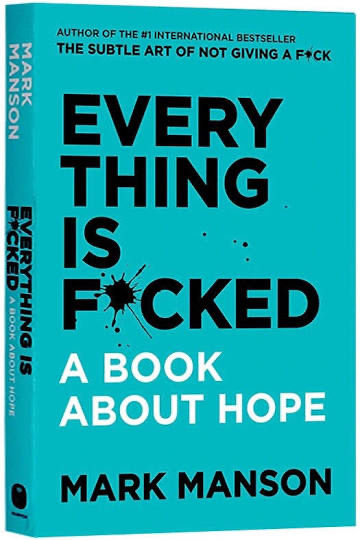
The above text contained some abbreviations from the book:
"Everything is F*cked A Book About Hope" by Mark Manson
Examples of Unconscious Limiting Beliefs in Daily Life
A few examples of limiting beliefs affecting our daily life without even noticing how they dictate our perception of reality and make us behave in twisted ways...
"I feel guilty if I don't help others"
"I need to change others to feel safe"
" I need to numb myself to feel happy"
When numbing becomes a way to avoid pain, fear or uncomfortable truths, the relief may be temporary while the unidentified pattern remains untouched. I explore this further in Holistic Addiction Recovery: Breaking the Trance & Healing the Aura.
"I need to feel happy all the time"

"I need many people and objects around me to feel good about myself"
The same conditioning can shape how we understand wealth and abundance. When money, possessions, freedom and lifestyle repeatedly become symbols of success, it becomes easy to confuse material abundance with spiritual fulfilment. I explore this further in How to Redefine Abundance Mindset: Manifest True Wealth and Prosperity Beyond Money.

"I need to keep myself busy"
"I need to control circumstances and outcomes to feel secure"
"I need him or her for benefits"
When another person is approached mainly through what they can provide - comfort, validation, status, sex, security or emotional benefit - the relationship itself can become filtered through expectation rather than honest connection. I explore a different perspective on soul connections, relationship lessons and romanticised beliefs in The Myth About TWIN FLAME.

"I need to be heard and acknowledged by others to feel worthy"
The need for external recognition can go much deeper than social approval. I explore how validation, status and the need to prove oneself arise from ego-identification in The Ego’s Hidden Game: Why Humanity Tries to Prove Its Existence.

"If I put him or her down I feel strong"
"I can't speak the truth, because otherwise I'm not liked"
"I need to please others to be loved"
When self-worth depends on approval, pleasing others or being acknowledged, limiting beliefs can quietly shape both our relationships and our choices. I explore this further in Reclaiming Self-Worth: Breaking Limiting Beliefs and Embracing Your Inner Value.
Marketing, Politics, and the Manipulation of Limiting Beliefs
Many politicians and companies, consciously or unconsciously, use slogans and messages that can activate existing beliefs, fears and desires within individuals or the collective.
Leadership, marketing and unconscious limiting beliefs can all influence public perception, sometimes shaping decisions more strongly than facts alone.
A statement can also sound completely convincing when the person making it genuinely believes it to be true. Conviction and truth, however, are not necessarily the same thing.
As one personal example, I once used a pendulum to examine a former Estonian prime minister’s New Year interview around 2022/23. My pendulum reading indicated approximately 20% truth. This was a result obtained through the dowsing method, not an independently verified fact-check.
Pendulum work can be used as a spiritual and reflective tool for examining questions, beliefs and personal decisions. If you are interested in learning how to work with your own questions through higher-self connection, I offer Pendulum Dowsing & Coaching.

Awaken to Truth: Tools to Detect and Release Limiting Beliefs
With intuitive tools like a pendulum, one can tap into the collective consciousness and the consciousness of any individual at any given moment.
The pendulum and other intuitive tools may also be used to detect lies from truth and also which limiting beliefs are affecting.
Pendulum dowsing can be used to ask direct questions through Higher Self connection. Besides asking whether something is true or false, you may investigate what further questions need to be asked. This kind of inquiry is different from analysing available data or information. AI can compare sources and documented evidence, but it cannot access Higher Self or perform higher self connection through pendulum dowsing or other similar tools used to connect with hihger consciousness.
Friends or family may behave according to the limiting beliefs often demanding to behave the same way as they do - according to what they believe is true.
And what may not be actually be the truth - just their perspective.
*The value of the process is not in accepting the first answer blindly, but in continuing to question from different angles until the underlying pattern becomes clearer.

Besides using the pendulum, another way to become aware of one's limiting beliefs is through hypnosis.
With openness to explore, through the Subconscious its possible reveal unconscious limiting beliefs, so that they lose their power.
Thus giving the option to start choosing from pure intentions.
I intend to assist others with awakening to the truth. Truth is the best healer.
Book Your Healing Session to Overcome Limiting Beliefs
You may book a pendulum session or teaching session on how to use the pendulum,
a day with me for hypnosis online or in person.
48 hour homestay retreat include how to use intuitive tools in daily life and DEPROGRAMMING retreats from lies and limiting beliefs accumulated from this and other lives.
You may also inquire about 21 day retreats for letting go of deeper habits.
Contact higherconsciousnessenergy@hotmail.com
for mutual availability and more info and bookings
Marketing Psychology, Limiting Beliefs & Inner Balance: Questions People Ask
How can I tell whether a desire is really mine or shaped by marketing?
A useful starting point is to notice whether the desire remains when the advertisement, trend, social pressure or promised identity is removed. Meditation and quiet observation can help reveal whether a choice comes from genuine preference or from a limiting belief seeking approval, security, status or comfort.
Can meditation and visualisation help me become more aware of limiting beliefs?
Meditation creates space to observe thoughts and reactions rather than automatically follow them. Higher-consciousness visualisations can also be used to shift attention inward, helping you notice recurring beliefs, emotional triggers and external influences more clearly.
Can hypnosis help me explore unconscious limiting beliefs?
Yes. Higher Consciousness Hypnosis is used to explore beliefs and patterns that may be ruling your conscious awareness. The purpose is not to replace one belief with another, but to witness what is influencing your choices and release what is no longer true for you. Higher Consciousness Hypnosis is available remotely worldwide and in person by arrangement.
Can I book a combined Reiki and hypnosis session in Amsterdam?
Yes. Reiki and hypnosis can be combined by arrangement in Amsterdam or remotely Worldwide. Reiki may support relaxation and energetic balance, while hypnosis allows deeper examination of beliefs, emotions and patterns through higher consciousness. Contact Dorit first to discuss availability and the most suitable format.
Where can I find Yin Yoga classes in Amsterdam?
Dorit offers private one-to-one Yin Yoga in Amsterdam, rather than standard group classes. Sessions may include meditation, breathwork, higher-consciousness visualisation and Cosmoenergy, with the practice adapted to your current state and intention. Private Yin Yoga Amsterdam & Online
Can Yin Yoga, meditation and visualisation help me find more balance within?
Private Yin Yoga can provide a quiet setting to slow down, observe the thoughts and reconnect with your true nature. Meditation and guided visualisation can be incorporated into the session to support inner stillness, awareness and release from constant external stimulation.
Where can I find holistic healing services near the centre of Amsterdam?
Dorit @Higher Consciousness Energy offers private one-to-one holistic healing in Amsterdam East, approximately twenty minutes from central Amsterdam. Available services include Reiki, Cosmoenergy, Higher Consciousness Hypnosis, QHHT, private Yin Yoga, spiritual guidance and readings, retreats. Explore Holistic Healing Services with Dorit.
Freedom of Expression & Editorial Context
This article presents the author's opinions, philosophical and spiritual perspectives, personal observations and findings obtained through practices including pendulum dowsing and Higher Self inquiry. It may question marketing, consumer culture, politics, collective beliefs, statistics, social conditioning and established interpretations.
Freedom to hold and communicate opinions and ideas is protected by Article 10 of the European Convention on Human Rights and Article 7 of the Dutch Constitution, with Article 11 of the EU Charter of Fundamental Rights applying within the scope of EU law. References to pendulum dowsing and Higher Self describe the author's own method of inquiry and the answers received through that practice.
Readers are encouraged to question, examine and decide for themselves.


Comments